
Most local businesses that have worked with an SEO agency have experienced some version of the same frustration. In the first month or two, there’s activity — an audit, some optimisations, maybe a report that lists all the things that were done. Then things go quiet. A monthly report arrives with some numbers. An occasional email with a recommendation. By month six, you’re not quite sure what you’re paying for.
This isn’t universal — there are genuinely active local SEO agencies that maintain rigorous monthly cadences. But it’s common enough that understanding what legitimate ongoing local SEO work actually looks like helps businesses distinguish real activity from the appearance of it.
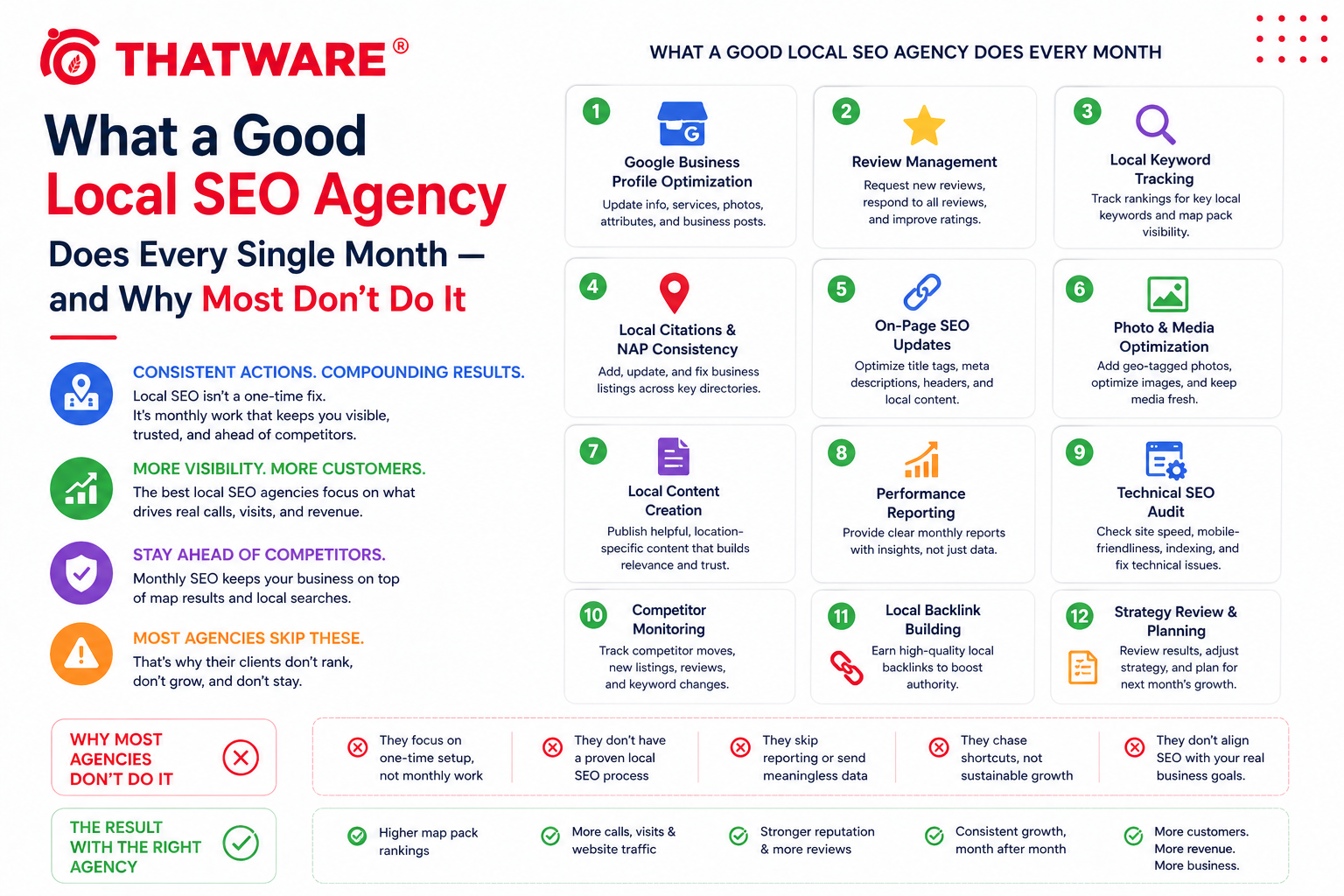
Here’s what a good local SEO agency actually does every month — and why the work is ongoing rather than a one-time project.
Google Business Profile: Active, Not Set-and-Forget
The single most important channel for local SEO is Google Business Profile, and it requires genuine monthly attention — not annual optimisation.
Review management. Reviews arrive continuously, and responding to them — both positive and negative — is an ongoing responsibility with direct SEO and reputation implications. Google has confirmed that review response signals are factored into local rankings. Responding to negative reviews in particular requires careful handling, especially in sectors with compliance constraints (healthcare, legal, financial services). A good agency either handles responses directly or provides the client with specific response language to approve.
GBP post management. Google Posts — updates, offers, events, news — have a short active life (typically 7 days for standard posts) and need to be published regularly. Consistent posting signals to Google that the business is active and engaged with its local presence. Most local businesses don’t maintain this without support.
Q&A monitoring and management. The Q&A section of a GBP listing is public and can be answered by anyone — including people who may provide incorrect information. Monthly monitoring and management of the Q&A section, seeding it with genuinely useful questions and accurate answers, is both a customer experience and a local SEO activity.
Photo updates. GBP listings with regularly updated, high-quality photos consistently perform better in local search and attract more profile views. Monthly photo updates — new interior shots, seasonal imagery, team photos — keep the listing visually current.
Insights monitoring. GBP provides data on search queries driving profile views, profile interactions (calls, direction requests, website clicks), and comparison data against category peers. Monthly review of these insights drives strategy adjustments and provides early warning of performance changes.
Citation Monitoring and Maintenance
Local citations — mentions of the business name, address, and phone number across directories, review sites, and local publications — are a foundational local SEO signal. The challenge is that they’re not stable.
Directories update their data. Businesses change addresses or phone numbers and the information propagates slowly and inconsistently. New citations get created with errors. Competitors sometimes attempt citation manipulation. Old citations with incorrect information persist for years.
Monthly citation auditing — checking the accuracy of the most important citations across the directories that matter in the local market, correcting errors, and removing or suppressing problematic duplicates — is ongoing maintenance work that never fully completes. The best local seo services providers maintain this as a regular activity rather than treating citation building as a one-time project.
Review Generation Support
Getting reviews is one of the most impactful local SEO activities a business can do, and it requires consistent effort — not a one-time email blast.
A structured review generation programme includes: identifying the right moments in the customer journey to request reviews (post-service, post-purchase, post-positive interaction), maintaining the systems for requesting reviews at scale (automated follow-up emails or text messages, review request cards for in-person businesses), and monitoring review acquisition across platforms to track volume and quality over time.
The monthly cadence includes reviewing the current review acquisition rate, identifying whether it’s on target, troubleshooting any issues with the review request flow, and making adjustments based on what’s working. It also includes identifying patterns in review sentiment that might flag service quality issues worth addressing.
Local Keyword Ranking Monitoring and Response
Ranking positions in local search — both the map pack and the organic local results — change continuously, driven by algorithm updates, competitive activity, and changes in Google’s local search landscape.
Monthly ranking monitoring should cover the primary local search queries across the client’s service areas, comparison of position against the specific competitors that matter, and identification of any significant changes in either direction.
Position improvements get reinforced — understanding what contributed to them and whether similar activity can extend the gains. Position declines get diagnosed — whether they reflect competitive moves, algorithm changes, technical issues, or content gaps — and a response is planned.
A local seo agency that isn’t doing this monitoring is flying blind. Changes in local rankings aren’t always obvious to business owners who aren’t monitoring them systematically, and early identification of negative trends allows response before the impact on leads and revenue becomes significant.
Local Content and Link Building Activity
Ongoing content and link acquisition in the local context are genuinely different from national SEO activities, and they require consistent effort.
Local content opportunities include: publishing content relevant to local community events, local industry developments, seasonal topics specific to the local market, and neighbourhood or regional information that’s useful to local searchers. A solicitor’s firm publishes guides to local property transactions. A dental practice publishing information about water fluoridation changes in the local water supply. A contractor writing about local building regulations updates. This content serves genuine local informational needs and builds local topical relevance.
Local link building involves building relationships with local business associations, local press and media, local event sponsors and partners, and local directory properties. These relationships take time to develop and require consistent outreach and follow-through — not a bulk email campaign run once.
The monthly activity here isn’t necessarily publishing a specific number of pieces or earning a specific number of links — it’s maintaining the consistent effort that, over time, builds a meaningful local authority profile.
Technical Monitoring
Local business websites have technical SEO needs like any other, and they require ongoing monitoring rather than one-time remediation.
Monthly technical monitoring includes: checking for broken links or pages returning error codes, verifying that mobile experience remains functional and performant (particularly important as mobile devices dominate local search), reviewing Core Web Vitals data for any regressions, and checking that structured data implementations remain error-free and accurate.
This is largely maintenance work — catching and fixing problems before they become significant rather than discovering them through traffic declines.
The Competitive Intelligence Dimension
Local markets change. Competitors open new locations, launch new marketing programmes, or begin investing more seriously in local search. New entrants arrive. Established players improve their GBP listings or begin generating reviews more aggressively.
Monthly competitive monitoring — checking competitor GBP listings, tracking their ranking positions, noting changes in their review volume or rating, identifying new citations they’ve acquired — keeps the strategy current and allows for proactive response rather than reactive damage control.
Reporting That Actually Means Something
All of this activity produces data, and the monthly reporting should translate that data into business insight — not just a dashboard of numbers.
The report should answer: what did we do this month, why did we do it, and what impact did it have? Are we on track against the objectives we set? What’s changed in the competitive landscape? What are the priorities for next month and why?
A report that says “organic traffic up 8%” without connecting that to lead volume, phone calls, or revenue impact is producing metrics, not insight. The businesses that get the most value from local SEO relationships are the ones where the agency connects their activity clearly to commercial outcomes — and is honest when the connection is unclear.
Why Most Agencies Don’t Do All of This
The honest answer is capacity and economics.
Running a genuine monthly programme across all the activities above requires meaningful time per client. At the pricing many local SEO agencies charge, the economics of running this programme properly for every client don’t work — the margin isn’t there to support the hours.
The result is one of two things: agencies that charge appropriately for the work and actually do it, or agencies that charge lower rates and automate or deprioritise significant portions of the programme.
When evaluating a local SEO agency, the right question isn’t “how much do you charge?” It’s “what specifically do you do every month?” Asking for a detailed description of monthly activities — specific, not generic — and evaluating whether that description matches the programme described above is the most reliable way to distinguish genuine ongoing service from the appearance of it.
The businesses that work with agencies actually running this programme consistently see their local search visibility grow, their review volume increase, and their lead flow from local organic search develop into a meaningful and reliable channel. It just requires choosing an agency that actually does the work.